Sunday, September 2, 2012


Saturday, September 1, 2012
The Denis Ovans are coming over, Dear
Humans, Neanderthals related to yet another group
From a finger bone, scientists have
reconstructed the genetic world of an entire population of extinct human
relatives called Denisovans. But questions still abound about who
exactly they were.
They weren’t quite like modern humans or Neanderthals, but some other
group entirely. Everything we know about the Denisovans is based on a finger bone and two teeth.Those small remnants, found in a cave in southern Siberia, are enough to figure out a few important things about these ancient people - including that some people today share genes with them.
For the first time, scientists have sequenced the Denisovan genome, with a quality that is about as high as the genome of a person alive today. That means scientists can learn about as much genetically about a person who lived tens of thousands of years ago as they could about a living person. The findings, published this week in the journal Science, deliver a wealth of insight about ancient people who roamed the Earth tens of thousands of years ago.
By comparing the genetics of modern humans with relatives in the evolutionary tree, it appears there are more than 100,000 genetic mutations that most people alive today share, but which our closest relatives in the evolutionary line did not have, said Svante Paabo, a biologist at the Max Planck Institute of Evolutionary Anthropology who led the research team.
Some of these genetic changes that are unique to humans have to do with brain function and brain development, Paabo noted.
“This is essentially a ‘genetic recipe’ ” for being a modern human, Paabo said in an e-mail. “Scientists can now start working on understanding how we differed from Denisovans and Neanderthals.”
Little is known about the Denisovans. Although some of their remains were found in southern Siberia, their genetic signature is not present today anywhere apart from islands in the Pacific. About 3% to 5% of the DNA of people from Melanesia (islands in the southwest Pacific Ocean), Australia and New Guinea as well as aboriginal people from the Philippines is from the Denisovans.
It’s only people in those places who have Denisovan DNA, Paabo said, which means the Denisovans must have been in Southeast Asia at one time.
By contrast, everyone who lives outside Africa today probably has some Neanderthal DNA in them, Paabo said in a news briefing Wednesday.
Paabo was reluctant to say Denisovans and Neanderthals were separate “species” but rather called them extinct “groups.”
More from Light Years: Fossils complicate human ancestor search
Scientists aren’t sure how old the finger bone used for the DNA sequence really is. Archaeologists date it to 30,000 to 50,000 years old, but based on genetics alone, the biologists who conducted this study believe it could be 80,000 years old. It appears to have belonged to a juvenile female. She may have had dark skin, brown hair and brown eyes, based on genetic associations.
The genome analysis suggests that our ancestors and the Denisovans’ ancestors must have split from each other as far back as 700,000 years ago, although there’s uncertainty around that number. But it appears the Denisovans mixed with (and mated with) indigenous people in Papua New Guinea and Australia, Paabo said.
“They probably became extinct about the same time as Neandertals when modern humans spread around the world,” Paabo said.
By sequencing single strands of ancient DNA, the researchers confirmed that interbreeding with humans must have occurred, and that Denisovans are related to Neanderthals, said Chris Stringer of the Natural History Museum London, who was not involved in the study.
The study also suggests that, on the whole, Europeans have less Neanderthal DNA than eastern populations. Even though Neanderthals mostly lived in Europe, people in eastern parts of Eurasia and Native Americans have more Neanderthal material than modern-day Europeans, said study co-author David Reich of Harvard University.
It could be that there were two separate gene flows into modern humans, or that there was a separate group of people who came from Africa into Europe but not Asia, said John Stewart of Bournemouth University, who was not involved in the study.
It appears the Denisovans had a low level of genetic diversity, which is consistent with Stewart and Stringer’s previous findings. Although scientists had only one finger bone to work with, a single person’s DNA contains signatures of a multitude of generations of ancestors.
This lack of diversity may also mean that Siberia wasn’t a core habitat for the Denisovans; perhaps they only went there during warm periods in small numbers but usually lived farther south.
Paabo’s study suggests the population may have begun small but quickly burgeoned, so genetic diversity didn’t have much time to increase. More research is needed to see if the Neanderthal population had a similar trajectory, the study found; if so, one single group of ancient creatures leaving Africa could have evolved into both Denisovans and Neanderthals.
Many questions remain unanswered, Stringer noted: What did Denisovans look like? Does the Denisovan DNA present in some humans today serve any function - and what about genetics from Neanderthals? Did Neanderthals and Denisovans mate with each other, too?
It’s likely that Denisovans and Neanderthals did interbreed, Stringer said, since they both lived in Eurasia for hundreds of thousands of years, and there’s Neanderthal DNA in a fossil foot bone discovered in the same Denisovan cave.
“Recognition of such interbreeding will inevitably complicate the untangling of the relationships between these ancient groups of humans, and their contributions to people today,” Stringer said.
Lughnasadh
| Lughnasadh | |
|---|---|
| Also called | Lúnasa (Modern Irish) Lùnastal (Scottish Gaelic) Luanistyn (Manx Gaelic) |
| Observed by | Historically: Gaels Today: Irish people, Scottish people, Manx people, Celtic neopagans |
| Type | Cultural, Pagan (Celtic polytheism, Celtic Neopaganism, Wicca) |
| Significance | Beginning of the harvest season |
| Begins | Northern Hemisphere: Sunset on July 31 Southern Hemisphere: Sunset on January 31 |
| Ends | Northern Hemisphere: Sunset on August 1 Southern Hemisphere: Sunset on February 1 |
| Celebrations | Offering of First Fruits Bonfires Feasting Handfasting |
| Related to | Calan Awst, Lammas |
In 1962 The Festival of Lughnasa, a study of Lughnasadh by folklorist Máire MacNeill, was published. MacNeill drew on medieval writings and on surveys and studies from throughout Ireland and Britain. Her conclusion was that the evidence testified to an ancient Celtic festival on 1 August that involved the following:
[A] solemn cutting of the first of the corn of which an offering would be made to the deity by bringing it up to a high place and burying it; a meal of the new food and of bilberries of which everyone must partake; a sacrifice of a sacred bull, a feast of its flesh, with some ceremony involving its hide, and its replacement by a young bull; a ritual dance-play perhaps telling of a struggle for a goddess and a ritual fight; an installation of a head on top of the hill and a triumphing over it by an actor impersonating Lugh; another play representing the confinement by Lugh of the monster blight or famine; a three-day celebration presided over by the brilliant young god or his human representative. Finally, a ceremony indicating that the interregnum was over, and the chief god in his right place again.[9]

Another custom that Lughnasadh shared with the other Gaelic festivals was the lighting of bonfires and visiting of holy wells. The ashes from Lughnasadh bonfires would be used to bless fields, cattle and people.[14] Visitors to holy wells would pray for health while walking sunwise around the well. They would then leave offerings; typically coins or clooties (see clootie well).[15]
In Gaelic Ireland, Lughnasadh was also a favored time for handfastings — trial marriages that would generally last a year and a day, with the option of ending the contract before the new year, or formalizing it as a lasting marriage.[7][16][17][18]
Modern Lughnasadh customs
Thursday, August 30, 2012
Uncle Hughie's Tavern in Jersey City New Jersey
http://www.youtube.com/watch?v=wymJMwzWnzs&feature=g-all-u
http://www.youtube.com/watch?v=wymJMwzWnzs&feature=g-all-u
right to the right of the Holland Tunnel, you took a couple of turns for the corner bar, Hughie's Tavern.
Jersey City, New Jersey.
My Godfather, Hugh Tumulty, ran a pub for I don't know how many years.
but I was there a couple of times, until he retired and sold it.
Not to me, of course, but wow, that would have been awesome, Aunt Nora's Bar...since I am Nora, Aunt Nora, and I have been a bartender.
Actually, my bar would be called Chez Nora or
Nora's Ark.
or something.
But, my career took a left turn and I'm not a bartender anymore.
http://www.youtube.com/watch?v=wymJMwzWnzs&feature=g-all-u
right to the right of the Holland Tunnel, you took a couple of turns for the corner bar, Hughie's Tavern.
Jersey City, New Jersey.
My Godfather, Hugh Tumulty, ran a pub for I don't know how many years.
but I was there a couple of times, until he retired and sold it.
Not to me, of course, but wow, that would have been awesome, Aunt Nora's Bar...since I am Nora, Aunt Nora, and I have been a bartender.
Actually, my bar would be called Chez Nora or
Nora's Ark.
or something.
But, my career took a left turn and I'm not a bartender anymore.
Wednesday, July 25, 2012
Muirdach's Cross
Muirdach's Cross (South Cross)
The cross near the entrance to the site is Muirdach's Cross (a.k.a Muiredach's Cross).
It dates from 900-923 AD and stands 5.5m (16 feet) tall. It is named
for an abbot mentioned in the inscription on the base: "A prayer for
Muirdach for whom the cross was made."
The carvings have not all been certainly identified, but on the eastern face,
from the bottom up, they appear to represent: the Fall of Adam and Eve
and the murder of Abel; David and Goliath; Moses bringing water from the
rock to the Israelites; the Three Magi bearing gifts to Mary and Jesus.
The center of the cross on the eastern face depicts the Last
Judgment, with the saved (led by David with a harp) on Christ's right
and the damned on his left; above that is St. Paul in the desert. These
seemingly unrelated scenes may be connected by the themes of sin,
judgment and atonement.

The western face of Muirdach's Cross focuses on
the New Testament and depicts, from the bottom up: the arrest or mocking
of Christ (who wears a robe and carries a sceptre); doubting Thomas
with another figure (perhaps St. John the Evangelist, who recorded the
story); Christ giving the keys of heaven to St. Peter and a book to St.
Paul; and Moses praying with Aaron and Hur.
In the central Crucifixion scene on the western face, Christ is
depicted as clothed and without pain (a typical Irish image). He is
flanked by two soldiers, the spearbearer who pierces his left side and
another holding a cane with a cup, apparently representing the
spongebearer. Between the soldiers and Christ's knees are two heads,
perhaps indicating the two thieves. The bird under Christ's feet may
represent the phoenix, a symbol of resurrection.
On the right arm of the cross is a depiction of the Resurrection of
Christ, with guards kneeling on each side of the tomb and three angels
behind them holding a small figure representing the soul. The cross is
capped with a stone replica of a gabled-roof church.
At the bottom of the western face, accompanied by two cats, is an
inscription translated as, "A prayer for Muiredach for whom (or by whom)
the cross was made."
Wednesday, May 23, 2012
The Irish Would Rather Be Quarreling than Lonely
The Number of my Dad's Navy Ship....
748
or
724
????
748
or
724
????
NavSource Online: Amphibious Photo Archive
USS LST-748


Awards, Citations and Campaign Ribbons
Precedence of awards is from top to bottom, left to right
Top Row - China Service Medal (extended) - American Campaign Medal - Asiatic-Pacific Campaign Medal (2)
Bottom Row - World War II Victory Medal - Navy Occupation Service Medal (with Asia clasp) - Philippines Liberation Medal (2)
Precedence of awards is from top to bottom, left to right
Top Row - China Service Medal (extended) - American Campaign Medal - Asiatic-Pacific Campaign Medal (2)
Bottom Row - World War II Victory Medal - Navy Occupation Service Medal (with Asia clasp) - Philippines Liberation Medal (2)
LST-542 Class Tank Landing Ship:
· Laid down, 2 April 1944, at Dravo Corp., Neville Island, Pittsburgh, PA.
· Launched, 13 May 1944
· Commissioned USS LST-748, 5 June 1944
· During World War II
USS LST-748 was assigned to the Asiatic-Pacific Theater and participated in the following campaigns:
|
Asiatic-Pacific Campaigns
|
|
|
Campaign and Dates
|
Campaign and Dates
|
|
Leyte operation
Leyte landings, November 1944 |
Luzon operation
Lingayen Gulf landings, January 1945 |
· Following World War II
USS LST-748 performed occupation duty in the Far East and saw service in China until mid-March 1945
· Decommissioned, date unknown
· Struck from the Naval Register, date unknown
· Final Disposition, transferred, 27 May 1948, to the Maritime Commission for disposal
· USS LST-748 earned two battle stars for World War II service
Specifications: (as reported by Office of Naval Intelligence-1945)
Displacement 1,625 t.(lt), 4,080 t.(fl) (sea-going draft w/1675 ton load)
Length 328' o.a.
Beam 50'
Draft
Displacement 1,625 t.(lt), 4,080 t.(fl) (sea-going draft w/1675 ton load)
Length 328' o.a.
Beam 50'
Draft
(light) - 2' 4" fwd, 7' 6" aft
(sea-going) 8' 3" fwd, 14' 1" aft
(landing) 3' 11" fwd, 9' 10" aft (landing w/500 ton load)
Speed 12 kts. (maximum)
Endurance 24,000 miles @ 9kts. while displacing 3960 tons
Complement
Speed 12 kts. (maximum)
Endurance 24,000 miles @ 9kts. while displacing 3960 tons
Complement
7 officers, 104 enlisted
Troop Accommodations
Troop Accommodations
16 officers, 147 enlisted
Boats 2 LCVP
Cargo Capacity (varied with mission - payloads between 1600 and 1900 tons)
Boats 2 LCVP
Cargo Capacity (varied with mission - payloads between 1600 and 1900 tons)
Typical loads
One
Landing Craft Tank (LCT), tanks, wheeled and tracked vehicles,
artillery, construction equipment and military supplies. A ramp or
elevator forward allowed vehicles access to tank
deck from main deck
Additional
capacity included sectional pontoons carried on each side of vessel
amidships, to either build Rhino Barges or use as causeways. Married to
the bow ramp, the causeways would
enabled payloads to be delivered ashore from deeper water or where a
beachhead would not allow the vessel to be grounded forward after
ballasting
Armament (varied with availability when each vessel was outfitted. Retro-fitting was accomplished throughout WWII. The ultimate armament design for United States vessels was
Armament (varied with availability when each vessel was outfitted. Retro-fitting was accomplished throughout WWII. The ultimate armament design for United States vessels was
2 - Twin 40MM gun mounts w/Mk. 51 directors
4 - Single 40MM gun mounts
12 single 20MM gun mounts
Propulsion two General Motors 12-567, 900hp diesel engines, two shafts, twin rudders
Propulsion two General Motors 12-567, 900hp diesel engines, two shafts, twin rudders
|
Click On Image
For Full Size Image |
Size
|
Image Description
|
Contributed
By |
 |
32k
|
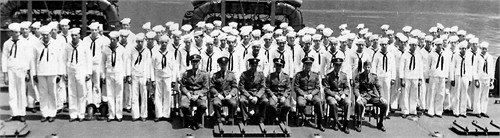
USS LST-748 commissioning crew photo, 5 June 1944, at Dravo Corp., Neville Island, Pittsburgh, PA.
|
Friday, May 18, 2012


Monday, March 19, 2012
Sunday, March 18, 2012
Switching Heads dot com
: tom sullivan <oxfordct2000@yahoo.com> [Edit Address Book]
To: artechno7@earthlink.net
Cc: "William.Boyle@chartisinsurance.com" <William.Boyle@chartisinsurance.com>
Subject: Re: Switching Heads
Date: Jan 13, 2011 10:31 AM
|
Subscribe to:
Comments (Atom)