BOYLE, BOYLE,

TROUBLE AND TOIL...

Saturday, September 1, 2012

Lughnasadh

Lughnasadh
Also called Lúnasa (Modern Irish)
Lùnastal (Scottish Gaelic)
Luanistyn (Manx Gaelic)
Observed by Historically: Gaels
Today: Irish people, Scottish people, Manx people, Celtic neopagans
Type Cultural,
Pagan (Celtic polytheism, Celtic Neopaganism, Wicca)
Significance Beginning of the harvest season
Begins Northern Hemisphere: Sunset on July 31
Southern Hemisphere: Sunset on January 31
Ends Northern Hemisphere: Sunset on August 1
Southern Hemisphere: Sunset on February 1
Celebrations Offering of First Fruits
Bonfires
Feasting
Handfasting
Related to Calan Awst, Lammas
Lughnasadh (pronounced LOO-nə-sə; Irish: Lúnasa; Scottish Gaelic: Lùnastal; Manx: Luanistyn) is a traditional Gaelic holiday celebrated on 1 August. It originated as a harvest festival, corresponding to the Welsh Calan Awst and the English Lammas.

In 1962 The Festival of Lughnasa, a study of Lughnasadh by folklorist Máire MacNeill, was published. MacNeill drew on medieval writings and on surveys and studies from throughout Ireland and Britain. Her conclusion was that the evidence testified to an ancient Celtic festival on 1 August that involved the following:
[A] solemn cutting of the first of the corn of which an offering would be made to the deity by bringing it up to a high place and burying it; a meal of the new food and of bilberries of which everyone must partake; a sacrifice of a sacred bull, a feast of its flesh, with some ceremony involving its hide, and its replacement by a young bull; a ritual dance-play perhaps telling of a struggle for a goddess and a ritual fight; an installation of a head on top of the hill and a triumphing over it by an actor impersonating Lugh; another play representing the confinement by Lugh of the monster blight or famine; a three-day celebration presided over by the brilliant young god or his human representative. Finally, a ceremony indicating that the interregnum was over, and the chief god in his right place again.[9]
People climbing Croagh Patrick on "Reek Sunday"
Lughnasadh celebrations were commonly held on hilltops. Traditionally, people would climb hills on Lughnasadh to gather bilberries, which were eaten on the spot or saved to make pies and wine.[10] It is thought that Reek Sunday—the yearly pilgrimage to the top of Croagh Patrick in County Mayo in late July—was originally a Lughnasadh ritual.[11] As with the other Gaelic seasonal festivals (Imbolc, Beltane and Samhain), the celebrations involved a great feast.[12] In the Scottish Highlands, people made a special cake called the lunastain, which was also called luinean when given to a man and luineag when given to a woman. This may have originated as an offering to the gods.[13]
Another custom that Lughnasadh shared with the other Gaelic festivals was the lighting of bonfires and visiting of holy wells. The ashes from Lughnasadh bonfires would be used to bless fields, cattle and people.[14] Visitors to holy wells would pray for health while walking sunwise around the well. They would then leave offerings; typically coins or clooties (see clootie well).[15]
In Gaelic Ireland, Lughnasadh was also a favored time for handfastings — trial marriages that would generally last a year and a day, with the option of ending the contract before the new year, or formalizing it as a lasting marriage.[7][16][17][18]

Modern Lughnasadh customs

Thursday, August 30, 2012

Uncle Hughie's Tavern in Jersey City New Jersey

http://www.youtube.com/watch?v=wymJMwzWnzs&feature=g-all-u

right to the right of the Holland Tunnel, you took a couple of turns for the corner bar, Hughie's Tavern.
Jersey City, New Jersey.  
My Godfather, Hugh Tumulty, ran a pub for I don't know how many years.
but I was there a couple of times, until he retired and sold it.
Not to me, of course, but wow, that would have been awesome,  Aunt Nora's Bar...since I am Nora, Aunt Nora, and I have been a bartender.
Actually, my bar would be called Chez Nora or
Nora's Ark.
or something.
But, my career took a left turn and I'm not a bartender anymore.

Wednesday, July 25, 2012

Muirdach's Cross

Muirdach's Cross (South Cross)

The cross near the entrance to the site is Muirdach's Cross (a.k.a Muiredach's Cross). It dates from 900-923 AD and stands 5.5m (16 feet) tall. It is named for an abbot mentioned in the inscription on the base: "A prayer for Muirdach for whom the cross was made."
The carvings have not all been certainly identified, but on the eastern face, from the bottom up, they appear to represent: the Fall of Adam and Eve and the murder of Abel; David and Goliath; Moses bringing water from the rock to the Israelites; the Three Magi bearing gifts to Mary and Jesus.
The center of the cross on the eastern face depicts the Last Judgment, with the saved (led by David with a harp) on Christ's right and the damned on his left; above that is St. Paul in the desert. These seemingly unrelated scenes may be connected by the themes of sin, judgment and atonement.


The western face of Muirdach's Cross focuses on the New Testament and depicts, from the bottom up: the arrest or mocking of Christ (who wears a robe and carries a sceptre); doubting Thomas with another figure (perhaps St. John the Evangelist, who recorded the story); Christ giving the keys of heaven to St. Peter and a book to St. Paul; and Moses praying with Aaron and Hur.
In the central Crucifixion scene on the western face, Christ is depicted as clothed and without pain (a typical Irish image). He is flanked by two soldiers, the spearbearer who pierces his left side and another holding a cane with a cup, apparently representing the spongebearer. Between the soldiers and Christ's knees are two heads, perhaps indicating the two thieves. The bird under Christ's feet may represent the phoenix, a symbol of resurrection.
On the right arm of the cross is a depiction of the Resurrection of Christ, with guards kneeling on each side of the tomb and three angels behind them holding a small figure representing the soul. The cross is capped with a stone replica of a gabled-roof church.
At the bottom of the western face, accompanied by two cats, is an inscription translated as, "A prayer for Muiredach for whom (or by whom) the cross was made."

Wednesday, May 23, 2012

The Irish Would Rather Be Quarreling than Lonely

The Number of my Dad's Navy Ship....

748
or
724
????

NavSource Online: Amphibious Photo Archive

USS LST-748

Description: http://www.navsource.org/archives/09/november.jpgDescription: http://www.navsource.org/archives/09/golf.jpgDescription: http://www.navsource.org/archives/09/echo.jpgDescription: http://www.navsource.org/archives/09/xray.jpg
International Radio Call Sign:
November - Golf - Echo - Xray
NGEX

Awards, Citations and Campaign Ribbons


Precedence of awards is from top to bottom, left to right
Top Row - China Service Medal (extended) - American Campaign Medal - Asiatic-Pacific Campaign Medal (2)
Bottom Row - World War II Victory Medal - Navy Occupation Service Medal (with Asia clasp) - Philippines Liberation Medal (2)

LST-542 Class Tank Landing Ship:
·  Laid down, 2 April 1944, at Dravo Corp., Neville Island, Pittsburgh, PA.
·  Launched, 13 May 1944
·  Commissioned USS LST-748, 5 June 1944
·  During World War II USS LST-748 was assigned to the Asiatic-Pacific Theater and participated in the following campaigns:
Asiatic-Pacific Campaigns
Campaign and Dates
Campaign and Dates
Leyte operation
Leyte landings, November 1944
Luzon operation
Lingayen Gulf landings, January 1945
·  Following World War II USS LST-748 performed occupation duty in the Far East and saw service in China until mid-March 1945
·  Decommissioned, date unknown
·  Struck from the Naval Register, date unknown
·  Final Disposition, transferred, 27 May 1948, to the Maritime Commission for disposal
·  USS LST-748 earned two battle stars for World War II service

Specifications: (as reported by Office of Naval Intelligence-1945)
Displacement 1,625 t.(lt), 4,080 t.(fl) (sea-going draft w/1675 ton load)
Length 328' o.a.
Beam 50'
Draft
(light) - 2' 4" fwd, 7' 6" aft
(sea-going) 8' 3" fwd, 14' 1" aft
(landing) 3' 11" fwd, 9' 10" aft (landing w/500 ton load)
Speed 12 kts. (maximum)
Endurance 24,000 miles @ 9kts. while displacing 3960 tons
Complement
7 officers, 104 enlisted
Troop Accommodations
16 officers, 147 enlisted
Boats 2 LCVP
Cargo Capacity (varied with mission - payloads between 1600 and 1900 tons)
Typical loads
One Landing Craft Tank (LCT), tanks, wheeled and tracked vehicles, artillery, construction equipment and military supplies. A ramp or elevator forward allowed vehicles access to tank deck from main deck
Additional capacity included sectional pontoons carried on each side of vessel amidships, to either build Rhino Barges or use as causeways. Married to the bow ramp, the causeways would enabled payloads to be delivered ashore from deeper water or where a beachhead would not allow the vessel to be grounded forward after ballasting
Armament (varied with availability when each vessel was outfitted. Retro-fitting was accomplished throughout WWII. The ultimate armament design for United States vessels was
2 - Twin 40MM gun mounts w/Mk. 51 directors
4 - Single 40MM gun mounts
12 single 20MM gun mounts
Propulsion two General Motors 12-567, 900hp diesel engines, two shafts, twin rudders

Click On Image
For Full Size Image
Size
Image Description
Contributed
By
Description: LST-748
32k
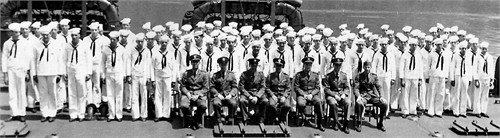
USS LST-748 commissioning crew photo, 5 June 1944, at Dravo Corp., Neville Island, Pittsburgh, PA.